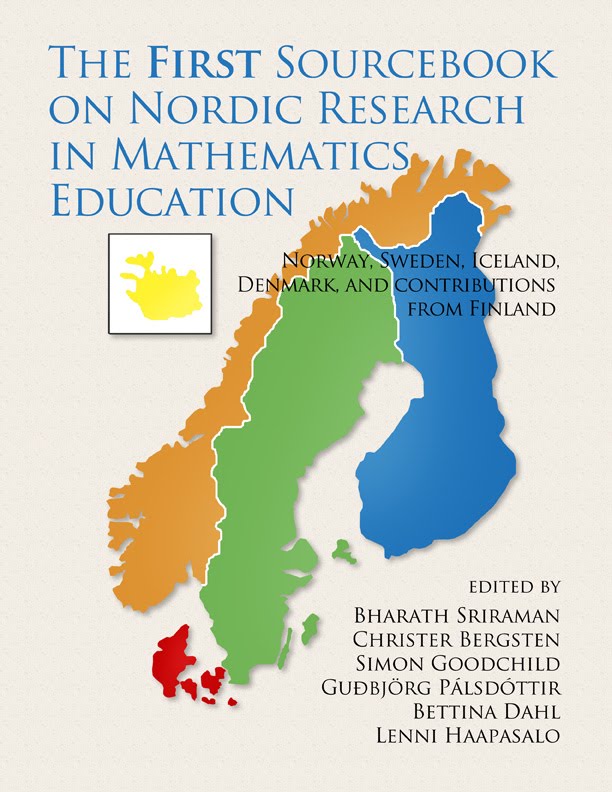
First Sourcebook on Nordic Research in Mathematics Education

The First Sourcebook on Nordic Research in Mathematics Education is going to be released in July this year, and I have been given the opportunity by the main editor, Professor Bharath Sriraman, to publish the cover photo and the table of contents first, here on this blog!

Being the first one to provide this news is of course great, and I guess that I am also enthusiastic about the book because I am one of the authors. The main reason why I am really enthusiastic about this book, however, is that it is going to be a monumental documentation of Nordic research and contributions to the field of mathematics education research. Putting together a book like this is a feature in itself, and I tip my hat to Bharath and the co-editors for this effort! I am happy that I have been able to be a part of it, and I am looking forward to digging into it! And I am quite certain that the hopes, which are expressed by the main editor in the foreword, are going to become true when it comes to this book. It will be “of use to many generations of mathematics education researchers inside and outside the Nordic world” (p. xii).
So, keep an eye on the publisher’s website at http://www.infoagepub.com/products/First-Sourcebook-Nordic-Research-Mathematics-Education to make sure you don’t miss the release date! And, in the meantime you can build your expectations by reading the table of contents as well as the foreword below:

TheFirstNordicSourcebook_TOC

Theories of Mathematics Education – Recommendations from Reuben Hersh

“Theories of Mathematics Education: Seeking new frontiers” is the first book in the series: Advances in Mathematics Education. The book was published a while ago, and it has already received good reviews and recommendations. The last in line to recommend the book is Reuben Hersh, and he has some very positive things to say about it:

A very impressive new book, “Theories of Mathematics Education” (Springer) edited by Sriraman and English is meant to inaugurate a new series, “Advances in Mathematics Education” . This first book in the series is a massive and ambitious undertaking, a very wide-ranging survey written in a dialogic format. (See this link for more!)

New issue of IJMEST, vol 41, issue 3, 2010

A new issue of International Journal of Mathematical Education in Science and Technology has been released, and it contains a whole host of interesting articles and classroom notes. This issue appears to have a particular focus on the use of technology in mathematics teaching, and here is a list of the original articles that are contained in the issue:

Review of my blog

After a slow month (on the blog – not at work!), it is great to see someone writing a nice review of this blog. This time it is Jerry Johnson from MathNEXUS who has written a very kind review. MathNEXUS is a web site particularly geared towards teachers of mathematics, and it presents itself as a mathematics portal with “news and ideas for teachers and learners of mathematics. So, if you’re into teaching and/or learning of mathematics it might be worthwhile to check it out!

Thanks for the kind words, Jerry 🙂

Exploring kindergarten teachers’ pedagogical content knowledge of mathematics

Last week, an interesting article was published online in the International Journal of Early Childhood. The article is entitled Exploring Kindergarten Teachers’ Pedagogical Content Knowledge of Mathematics, and it has been written by Joohl Lee. The combination of teachers knowledge of mathematics and kindergarten is very interesting, and while a lot of research has been done to learn more about the type of knowledge mathematics  teachers need in school, little has been done to learn more about this in kindergarten. This is also mentioned by Lee in the article. As the title of the article reveals, Lee builds upon Shulman’s traditional framework of teachers’ professional knowledge. What I don’t understand, however, is how it is possible to write an article about teachers’ pedagogical content knowledge of mathematics without making any reference to the MKT (Mathematical Knowledge for Teaching) framework, or any of the work done by Deborah Ball and her colleagues at the University of Michigan. I understand that this article has a focus on kindergarten, but still… I also think there should be some mention of how the teachers in the study were selected. 81 kindergarten teachers were assessed in the study, and 55% of these had a master’s degree. I would like to know more about how representative this sample was. Still, I think it is an interesting article, and I think it is a good thing that the issue of kindergarten teachers’ knowledge of mathematics is addressed.

Here is the abstract of the article:

The purpose of this study was to assess 81 kindergarten teachers’ pedagogical content knowledge of mathematics on six subcategory areas such as number sense, pattern, ordering, shapes, spatial sense, and comparison. The data showed participants possessed a higher level of pedagogical content knowledge of “number sense” (M = 89.12) compared to other mathematics pedagogical content areas. The second highest scores among six subcategories of pedagogical content knowledge of mathematics was for the pedagogical content area of “pattern” (M = 82.33). The lowest scores among those six subcategories of kindergarten teachers’ pedagogical content knowledge were obtained from the subcategory of “spatial sense” (M = 44.23), which involved the means to introduce children to spatial relationships. The second lowest score was obtained for the subcategory of “comparison” (M = 50.40) which involved the means to introduce the concept of graphing and the use of a balance scale for measurement.

Busy days…

The last couple of weeks have been extremely busy – for many reasons – and I haven’t been able to follow up on all the latest articles and news in the field. I apologize for this, and I hope that all the readers of the blog have patience with me! I promise that I will catch up 🙂

In the meantime, you always have a couple of good options in order to stay really up-to-date:

These two sites are a bit easier for me to update, and when I don’t manage to update my blog as often as I would, I will probably continue to push new updates to these two other services. Still, as soon as I get my head above water again, I will keep providing you with information here as well 🙂

Mathematically based and practically based explanations

Esther Levenson, Pessia Tsamir and Dina Tirosh have written an interesting article about Mathematically based and practically based explanations in the elementary school: teachers’ preferences. Their article was published online in Journal of Mathematics Teacher Education on Friday. In this article, the authors make interesting connnections between research on teachers’ knowledge and beliefs. Although their focus is on knowledge and beliefs in relation to the use of explanations (and they distinguish between mathematically and practically based explanations) in the classroom, the article makes a nice contribution to extending our understanding of the way these concepts are related. The part of teachers’ knowledge (and beliefs) that the authors discuss is related to students’ thinking, or even a sub-category of that. In this respect, they make valuable contributions to what Deborah Ball and her colleagues refer to as Knowledge of Content and Students, but their focus is also in the borderline of what is referred to as Knowledge of Content and Teaching. The links to research concerning teachers’ beliefs is also interesting, althought the authors don’t go into great detail here. They are, of course, aware of this, and explain that they have only given “a glimpse into the complexity of the relationship between teachers’ knowledge and beliefs”, in particular with focus on teachers’ use of explanations.

Here is the abstract of their article:

This article focuses on elementary school teachers’ preferences for mathematically based (MB) and practically based (PB) explanations. Using the context of even and odd numbers, it explores the types of explanations teachers generate on their own as well as the types of explanations they prefer after reviewing various explanations. It also investigates the basis for these preferences. Results show that teacher-generated explanations include more MB explanations than PB explanations. However, many still choose to use mostly PB explanations in their classrooms, believing that these explanations will be most convincing to their students. The implications for teacher education are discussed.

Integrating technology into mathematics teaching

Zsolt Lavicza has written an article entitled Integrating technology into mathematics teaching at the university level. This article was published online in ZDM on Friday. Here is the abstract of the article:

The emergence of new computing technologies in the second half of the twentieth century brought about new potentials and promised the rapid transformation of the teaching and learning of mathematics. However, despite the vast investments in technology resources for schools and universities, the realities of schooling and the complexities of technology-equipped environments resulted in a much slower integration process than was predicted in the 1980s. Hence researchers, together with teachers and mathematicians, began examining and reflecting on various aspects of technology-assisted teaching and learning and on the causes of slow technology integration. Studies highlighted that as technology becomes increasingly available in schools, teachers’ beliefs and conceptions about technology use in teaching are key factors for understanding the slowness of technology integration. In this paper, I outline the shift of research focus from learning and technology environment-related issues to teachers’ beliefs and conceptions. In addition, I highlight that over the past two decades a considerable imbalance has developed in favour of school-level research against university-level research. However, several changes in universities, such as students declining mathematical preparedness and demands from other sciences and employers, necessitate closer attention to university-level research. Thus, I outline some results of my study that aimed to reflect on the paucity of research and examined the current extend of technology use, particularly Computer Algebra Systems (CAS) at universities, mathematicians’ views about the role of CAS in tertiary mathematics teaching, and the factors influencing technology integration. I argue that due to mathematicians’ extensive use of CAS in their research and teaching, documenting their teaching practices and carrying out research at this level would not only be beneficial at the university level but also contribute to our understanding of technology integration at all levels.

Happy new year!

I want to wish all readers of the Mathematics Education Research Blog a happy new year!

2009 was a nice year in many ways, and I am certain that 2010 will be a great year too! No matter what lies ahead, I will do my best to keep you up to date on what happens in the world of mathematics education research, with a particular emphasis on journals and scientific articles. Best of wishes to all of you, and I hope that 2010 will be a productive year for each and everyone of you!

Merry Christmas

I wish all of my readers a merry Christmas! Things are going to be somewhat slow here on the blog for a few days, but I promise to be back in early January with more news about mathematics education research!

If you want to stay up to date, you might consider checking my shared articles on Google Reader, or you can go directly to the automatically updated articles within the field of mathematics education. Articles related to education research in general can be found here, and articles related to early childhood education can be found here. You might also consider following me on twitter, where I will also provide news and updates about mathematics education and other things of interest.