A day of co-writing with Google Docs

Today has been one of those great days at work! I spent it together with two colleagues, with which I arranged a working seminar in a local hotel. Three researchers, each with his/her own laptop, and Google Docs. For quite some time now, we have used Google’s online office suite for all our collaborative writing projects. Since all the writing we do in connection with our project (focus of our project is on mathematical knowledge for teaching) is collaborative, it implies that we use it a lot. And most of the time we are quite happy about it! The latest update to Google Docs has some ups and downs though. On the positive side, real-time collaboration has become much more real-time. Not quite Gobby-real-time, but not bad! On the negative side, however, the new version is rather slow when using some browsers, and the new way of writing comments in the text is not an improvement in our view! Comments are too much disconnected with the text, and if you forget to reply in the proper way it soon becomes messy. We tend to use the old version for that reason. This is not perfect though, because the old version of Docs does not exactly provide real-time collaboration…

Perhaps it is time to start exploring Wave more seriously, or even set up Etherpad on our own server… Real-time collaboration is great, and easy access to your documents (with sharing) is great, but I still haven’t found the perfect solution it seems. Anyone wants to share their ideas about collaborative writing tools for academic writing?
Preservice teachers’ conceptions of multidigit wholenumbers

Eva Thanheiser (Portland State University) has written an interesting article that was published online in Educational Studies in Mathematics this week. The article is entitled Investigating further preservice teachers’ conceptions of multidigit whole numbers: refining a framework, and in the article, Thanheiser digs into the domain of (preservice) teachers’ content knowledge of mathematics. Here is the abstract of Thanheiser’s article:

This study was designed to investigate preservice elementary school teachers’ (PSTs’) responses to written standard place-value-operation tasks (addition and subtraction). Previous research established that PSTs can often perform but not explain algorithms and provided a four-category framework for PSTs’ conceptions, two correct and two incorrect. Previous findings are replicated for PSTs toward the end of their college careers, and two conceptions are further analyzed to yield three categories of incorrect views of regrouped digits: (a) consistently as 1 value (all as 1 or all as 10), (b) consistently within but not across contexts (i.e., all as 10 in addition but all as 1 in subtraction), and (c) inconsistently (depending on the task).

Teachers’ metacognitive behavior in problem solving

Mathematics education research appears to be blooming in Turkey, at least this is my personal impression about the seemingly increasing number of articles that are published by Turkish researchers. Handan Demircioğlu , Ziya Argün  and Safure Bulut have written an article about A case study: assessment of preservice secondary mathematics teachers’ metacognitive behaviour in the problem-solving process, and this article was recently published online in ZDM. The article reports from one of many studies on problem solving in Turkey, but when the other studies have focused on issues related to beliefs, problem solving strategies, etc., this one has a focus on the teachers’ metacognition. Here is the abstract of their article:

The purpose of the present study was to investigate preservice secondary mathematics teachers’ metacognitive behaviour in the mathematical problem-solving process. The case study methodology was employed with six preservice mathematics teachers, enrolled at one university in Ankara, Turkey. We collected data by using the think aloud method, which lasted for two sessions. It was found that there was no relationship between academic achievement and frequencies of metacognitive behaviour. However, the types of problems could affect these frequencies. Furthermore, there was no pattern in metacognitive behaviour with respect to achievement and type of problem.

First Sourcebook on Nordic Research in Mathematics Education

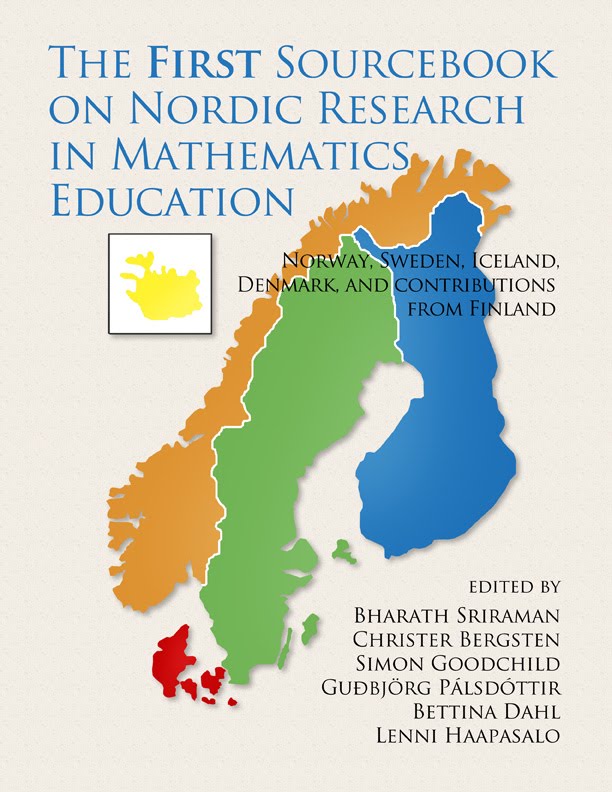
The First Sourcebook on Nordic Research in Mathematics Education is going to be released in July this year, and I have been given the opportunity by the main editor, Professor Bharath Sriraman, to publish the cover photo and the table of contents first, here on this blog!

Being the first one to provide this news is of course great, and I guess that I am also enthusiastic about the book because I am one of the authors. The main reason why I am really enthusiastic about this book, however, is that it is going to be a monumental documentation of Nordic research and contributions to the field of mathematics education research. Putting together a book like this is a feature in itself, and I tip my hat to Bharath and the co-editors for this effort! I am happy that I have been able to be a part of it, and I am looking forward to digging into it! And I am quite certain that the hopes, which are expressed by the main editor in the foreword, are going to become true when it comes to this book. It will be “of use to many generations of mathematics education researchers inside and outside the Nordic world” (p. xii).
So, keep an eye on the publisher’s website at http://www.infoagepub.com/products/First-Sourcebook-Nordic-Research-Mathematics-Education to make sure you don’t miss the release date! And, in the meantime you can build your expectations by reading the table of contents as well as the foreword below:

TheFirstNordicSourcebook_TOC

New issue of Journal of Mathematics Teacher Education

A new issue of Journal of Mathematics Teacher Education has been published (See SpringerLink – Journal Issue). The issue contains five interesting articles, all of them with a strong focus on inquiry:

Theories of Mathematics Education – Recommendations from Reuben Hersh

“Theories of Mathematics Education: Seeking new frontiers” is the first book in the series: Advances in Mathematics Education. The book was published a while ago, and it has already received good reviews and recommendations. The last in line to recommend the book is Reuben Hersh, and he has some very positive things to say about it:

A very impressive new book, “Theories of Mathematics Education” (Springer) edited by Sriraman and English is meant to inaugurate a new series, “Advances in Mathematics Education” . This first book in the series is a massive and ambitious undertaking, a very wide-ranging survey written in a dialogic format. (See this link for more!)

JMTE, April 2010

The April issue of Journal of Mathematics Teacher Education has recently been published. This issue contains 6 interesting articles:

The article by van Es and Sherin is an Open Access article, so that one should be available even for non-subscribers!

New issue of IJMEST, vol 41, issue 3, 2010

A new issue of International Journal of Mathematical Education in Science and Technology has been released, and it contains a whole host of interesting articles and classroom notes. This issue appears to have a particular focus on the use of technology in mathematics teaching, and here is a list of the original articles that are contained in the issue:

Review of my blog

After a slow month (on the blog – not at work!), it is great to see someone writing a nice review of this blog. This time it is Jerry Johnson from MathNEXUS who has written a very kind review. MathNEXUS is a web site particularly geared towards teachers of mathematics, and it presents itself as a mathematics portal with “news and ideas for teachers and learners of mathematics. So, if you’re into teaching and/or learning of mathematics it might be worthwhile to check it out!

Thanks for the kind words, Jerry 🙂

Appropriating geometric series as a cultural tool

A couple of new articles have been published online in Educational Studies in Mathematics lately, amongst those a very interesting one by my good colleague Martin Carlsen from the University of Agder, Norway. His article is entitled: Appropriating geometric series as a cultural tool: a study of student collaborative learning. Carlsen, along with other colleagues in Agder, have been influenced by the focus on small-group problem solving that was advocated by Neil Davidson and others some years ago. The Agder group is also strongly influenced by theories related to sociocultural perspectives of teaching and learning mathematics, and this article provides a nice overview of some of these theoretical foundations. The research reported in this article can be placed within a qualitative, naturalistic paradigm, and the data were analyzed using a dialogical approach (Carlsen here makes use of a framework developed by two other colleagues: Maria-Luiza Cestari and Raymond Bjuland). So, if you are interested in any of the perspectives referred to above, this article should be highly relevant for you! Here is the abstract of the article:

The aim of this article is to illustrate how students, through collaborative small-group problem solving, appropriate the concept of geometric series. Student appropriation of cultural tools is dependent on five sociocultural aspects: involvement in joint activity, shared focus of attention, shared meanings for utterances, transforming actions and utterances and use of pre-existing cultural knowledge from the classroom in small-group problem solving. As an analytical point of departure, four mathematical theoretical components are identified when appropriating the cultural tool of geometric series: (1) estimating of parameters, (2) establishing of the general term, (3) composing of the sum and (4) deciding on convergence. Analyses of five excerpts focused on the students’ social processes of knowledge objectification and the corresponding semiotic means, i.e., lecture notes, linguistic devices, gestures, head movements and gaze, to obtain shared foci and meanings. The investigation of these processes unveils the manner in which the students established links to pre-existing mathematical knowledge in the classroom and how they simultaneously combined the various mathematical theoretical components that go into appropriating the cultural tool of geometric series. From the excerpts, it is evident that the students’ participation changes throughout their involvement in the problem-solving process. The students are gaining mathematical knowing through a process of transforming and by establishing shared meanings for the concept and its theoretical components.